

Archive | Your City RSS feed for this section
Your City
How much is art worth to the city of St. John’s? Over the past few weeks city councilors have heard plenty of recommendations on how much money to spend, and now they have some decisions to make about arts funding for 2010. So what does this mean for the citizens of St. John’s, coming into a year of many tough economic questions? Let’s lay out the short and skinny of it.
WHAT THE ARTS ADVISORY COMMITTEE RECOMMENDS
The Municipal Arts Plan, written by the Arts Advisory Committee, was released with little fanfare during the election, and remained a non-issue late with all of the hype about mil rates and water bans. That plan recommends increasing per capita funding for city arts grants like so:
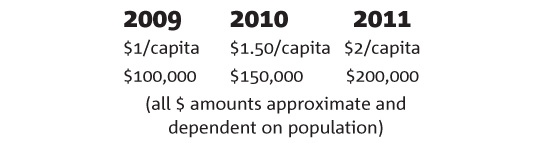
This would increase with every new person St. John’s attracts. The numbers above assume the city’s population won’t grow from 2009 to 2011. Given that St. John’s is one of a few places in the province seeing an increase in population, we would be likely to see funding exceed what’s written here.
WHAT THE ART PROCUREMENT JURY RECOMMENDS
How much art should the city buy? The last increase for this program was way back in 2002, when it was doubled from $10,000 to $20,000. Now the Jury respectfully recommends the budget be again doubled to $40,000. An increase of $20,000 is a relative drop in the $200 million bucket that the city’s 2010 budget is sure to be.
NOW WHAT?
All of these recommendations have been given to the budget committee for 2010.
That committee is currently consulting with the city’s various departments and committees—who wants what and who needs what in 2010. Lucky for you, the city is also encouraging public input on the whole thing.
The biggest budget decision might be the amount to decrease the mil rate—the rate used to calculate property taxes. A decrease in the mil rate of 1 per cent would mean a loss of just over $9.4 million to city’s coffers. Reductions of as much as 3 per cent have been muttered about since the fall election.
St. John’s is entering what is going to be a very profitable few years for some. As a city we need to decide where our priorities lie. If art is truly a priority to this city, as its many documents and plans state, St. John’s needs to put its money where its mouth is and find a way to increase funding to the arts in the 2010 budget.
I encourage you all to send your own priorities and ideas for the 2010 budget to a representative of council. A presentation on the 2010 budget, past budgets, and contact information for council members are available on the city’s website at www.stjohns.ca.
What do you think about municipal funding for the arts? Leave a comment below.
O’Keefe drops the A-bomb
Thu, Nov 19, 2009

By Andrew Harvey
Amalgamation and regional cooperation has been on the back-burner of provincial and municipal politics for some time now, but at the November 16th St. John’s city council meeting, mayor Dennis O’Keefe and the gang turned up the heat. Council unanimously voted to conduct a feasibility study on establishing a toll booth on the currently under-construction extension of the Team Gushue highway—a road which would stretch from Kenmount Road to the Goulds. O’Keefe went as far as to say the toll would be for non-St. John’s residents.
This all has come from Mount Pearl’s refusal to share the maintenance costs on the new extension. But their decision isn’t much of a surprise, considering Mount Pearl also refused to share the cost of the construction of the highway in the first place.
Over the last few months, letters have been flying between O’Keefe and Mount Pearl mayor Randy Simms, with O’Keefe asking Simms to recognize the benefit to Mount Pearl in the highway, and to pay 25 per cent of the maintenance costs for the highway. He cited a study which estimated 35 to 50 per cent of traffic on the new highway would come from Mount Pearl residents. But despite any traffic relief Mount Pearl might experience from the extension, no part of the highway extension is actually in Mount Pearl.
Simms has maintained all along that the highway is provincial jurisdiction, and they want no part in it.
“Establishing the precedent whereby municipal governments accept responsibility for provincial obligations is not one that we can justifiably entertain,” mayor Simms wrote in one of his letters.
In order to get funding to construct the highway extension, St. John’s agreed to take ownership of the highway. This leaves city council—and St. John’s taxpayers—responsible for the maintenance of the highway. And it’s expected to run $712,000 a year.
Councilor Gerry Colbert may have said it best, though, when he said “from the get-go, the road should have been cost-shared” adding that, “They won. They got a road for nothing.”
My hope is that coming out of this David versus Goliath inter-city tiff, municipalities of the North-East Avalon and across the province learn not to take ownership of things they don’t want full responsibility over. Play nice.


Thu, Dec 3, 2009
Andrew Harvey