

Archive | April 9th, 2009
Sticks & stones
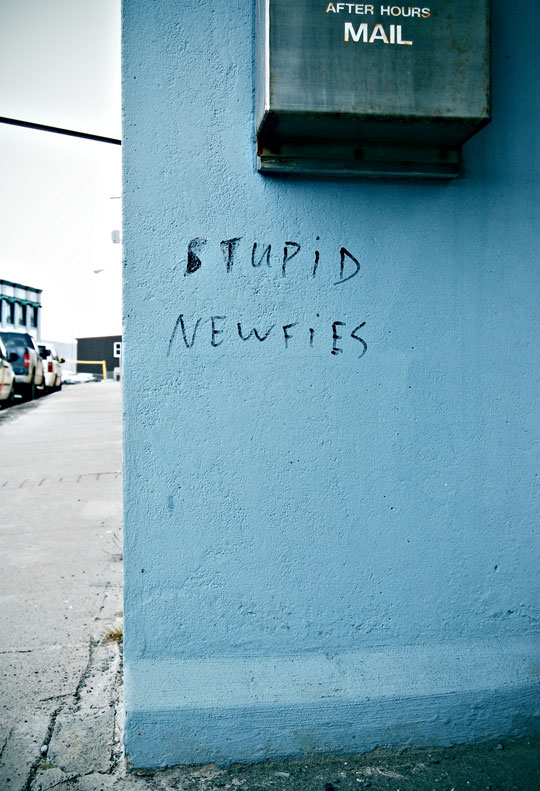
For some the word still cuts right to the bone. For others, it slides off the back. For even more, it has been chewed up and swallowed; used to help define who they are.
No one knows for sure where the word “Newfie” first came from, but it wasn’t truly until after April 1, 1949 that it started seriously taking root in our minds and the minds of other Canadians.
What is a Newfoundlander?
Newfoundlanders, what are we?
By the late 1960s, 20 years into Confederation, Newfie jokes had spread themselves thick across the mainland. For many Canadians, the word and the jokes became the first things to spring to mind about us and our island in the middle of the North Atlantic.
Flash forward to 2009—past the eventual collapse of the cod fishery, the outmigration of thousands to the mainland, and past years of economic reliance on the rest of the country—we have found ourselves in a position of relative, if tenuous, prosperity.
“Have” status. A “revolution between the ears.” “I don’t think the Newfie joke is there anymore,” our premier has said.
But even now we can’t honestly look at Newfoundland identity without also looking at that word. No matter how much some people try, there’s no scrubbing it away, burying it, or drowning it. Has it taken on new meaning? Is it less insulting than before?
What does it mean now?
It depends on who you ask.
Compiled and edited by Sarah Smellie, Elling Lien, and Bryhanna Greenough. Photos by Elling Lien.
—
WHAT DO YOU THINK?:
What do you think of the word “Newfie”? When’s the last time you heard it? Speak your mind here.
Cover issue 79
Thu, Apr 9, 2009
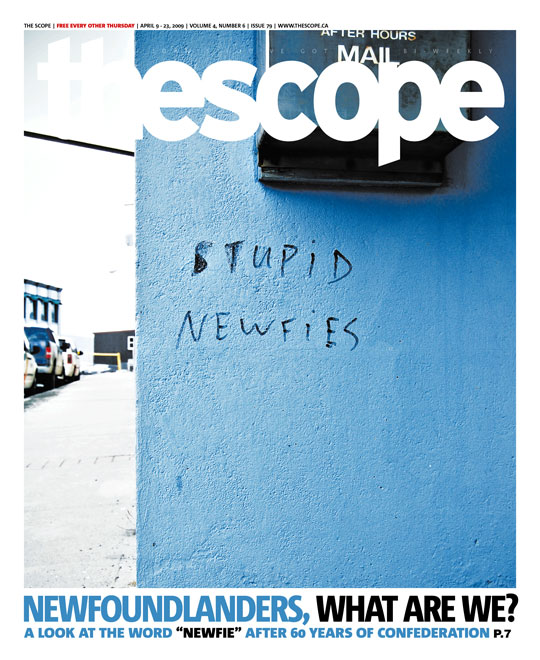
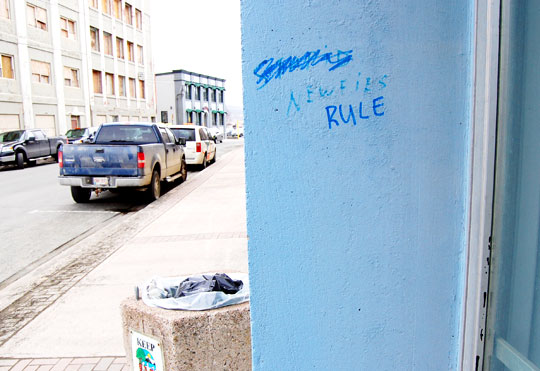
Cover photo by Elling Lien of the former CBC Radio building. The “stupid newfies” graffiti phenomenon first appeared two years ago.
WHAT DO YOU THINK?:
What do you think of the word “Newfie”? Speak your mind here.
“Newfie” panel discussion
Thu, Apr 9, 2009
NB: Neil Butler
Actor and writer. Tracks the online use of the word “Newfie” at newfieinuse.blogspot.com
RL: Ruth Lawrence
Actor, director, filmmaker. Executive Director of the Nickel Film Festival.
DB: Dan Banoub
Graduate student completing an honours thesis in Anthropology on the subject of Newfoundland identity and (former) employee of Fred’s Records.
TP: Tom Power
Musician and CBC Radio Two host of the weekly folk music program Deep Roots.
BJ: Bruce Johnson
Fine art curator at The Rooms, currently putting together an exhibit on the subject of Newfoundland identity for later this year.
—
What do you think when you hear the word “Newfie?”
NB: I’ll tell you what I want it to mean. I want it to mean someone whose misrepresenting Newfoundland at this point. I’d like to see the word redefined somehow. Someone that’s been removed so long they don’t actually know what’s going on here. But that doesn’t stop them from getting their back up whenever they’re talking about “Newfie”-land or whatever. Somebody misrepresenting Newfoundland. Let’s take the word back.
RL: It’s funny, I do think the term is going to change, I really hope it does. That other N-word I can’t say has become a prominent part of black culture, and after really so many people worked so hard for so many years to distance themselves from that word. How does the grandmother of an 18-year-old feel when she hears him say the N-word? She must think “my god, I failed, I failed.”
BJ: There seems to be two contexts for the word “Newfie”. Or there has been traditionally, when I heard it as a kid. One of them was from outsiders talking about Newfoundlanders—a “Newfie”. But then there was the export of the term “Newfie”. The “Newfie” brand was exported.
But now I think the culture has come into it’s own in a whole other way. Not that it hadn’t in the past, in the 70s that happened with CODCO, and lots of other things, people coming into their own. But I see a new kind of assurance these days. I work a lot with artists who are here. Twenty-somethings, thirty-somethings, and I think some of their attitudes are very self-assured.
NB: Newfoundlanders are always known, I guess, for going away. In the past it was on boats, I guess, but now Newfoundlanders are going away, seeing the world, and coming back.
BJ: Like going to the Giller Awards.
[laughter]
BJ: It filters into this idea that interests me—this nationalism that has popped up again now, and it’s beginning to be a bit of a fashion again. We’re reconsidering Newfoundland nationalism.
NB: I hope it lasts longer than a month this time.
BJ: Well I think there’s good reason now. Plenty of people are happy about lots of things. That “have”/”have-not” status change meant a lot to all of us, including people like me who had been a CFA 16 years ago. Changes are coming, and I think the word “Newfie” could be reclaimed. Just look at “queer”— that got reclaimed.
NB: About a year ago I changed my point of view on the word “Newfie”. I was like you, Ruth, and I said I wasn’t going to use that word, shag that word.
I self-identify as “fag.” I love that I’m a fag. Deal with it. But I realised there are people I respect and they call themselves “Newfie”. Nobody has a right to tell me what I’m going to call myself, so if someone says “I’m a Newfie,” well then, I’ve got to look at that word again.
RL: I have lots of friends who use it.
DB: A lot of people are not being mean when they’re saying it. I work at Fred’s and all summer I heard “I want to hear some ‘Newfie’ music.” They’re being nice, and they really do want to hear music from here— but should I tell them the word is kind of annoying? I’m always in that weird position. ‘You’re a nice person, you don’t mean anything bad by it, but you’re still kind of pissing me off.
RL: I’ve totally had people say it to me in an endearing way. It’s just one of those things that’s hard to judge. But its roots—in my experience the word has its roots in degradation. Anything that has its roots in degradation I have a really hard time seeing the other side of.
BJ: But even at Fred’s, when someone really nice comes in and says “we want to see the ‘Newfie’ section,” though it’s nice in intention, it’s based in paternalism, right? Like the minstrel show.
NB: I totally hear you. If it’s not that bad, it doesn’t have the violence associated with it that the other N-word does, should we suck it up? If we’ve been able to live on this rock with no topsoil for 500 years, why are we getting our jeans in a knot about it?
RL: Look at the cultures who’ve been joked about. The easiest example is Ireland. Suddenly Ireland became a thriving economy, with lots of their money coming from being the knowledge sector, as opposed to farming and traditional way of life, and suddenly, whose out making Irish jokes?
TP: Everyone. When I was in Europe, instead of two mainlanders and a Newfie, it was two English and an Irish. The Irish are still being made fun of.
And they’re still perpetuating the whole shamrock thing in a lot of areas of Ireland. You find in Cork they’re not so bad, but if you got to somewhere like Dublin, to the Trinity bar—the Irish jokes, the Irish pubs are there.
RL: It’s not that different from George Street in St John’s. I fully expect to hear a Newfie joke if I walk down George Street.
—
BJ: We often overlook the stereotypes that we like, that we embrace.
I went and asked a bunch of people today who were born here about the word “Newfie” and I was surprised by a lot of the answers, because a lot thought it was “endearing”, “it’s okay”, “it doesn’t bother me”, “why are you going on about it?” But immediately after I said that, these three people said, “well we like the name because we are such hospitable people, because we don’t have the kind of problems they have elsewhere; we aren’t racist…”
There are a lot of stereotypes there. Look at our tourism ads. They’re based on a stereotype we love, about Newfoundland being a friendly, safe place. And they’re based in some reality, I’m not saying they’re not. This is a safe place to bring up your kids, and people are generally friendlier than other places, but we do add a bit of hyperbole. And that hyperbole is an export, and we like to believe it.
So I think that goes with the word when we use it too. It goes with these other stereotypes which aren’t just about keeping your head down but are about keeping your head up. I think they both exist here.
TP: Maybe somebody whose dad owns the Irving in Appleton would have a completely different viewpoint on all this. …There’s a part of me that’s really hesitant to say anything because I feel like we see Newfoundland in a different way than many do. I’ve never had to live in Fort MacMurray and feel that loneliness and desperation and have to identify in that way in order to get along.
NB: Nope, I’m done pitying the “Newfies.”
TP: No, I’ve also never been in a place where you want to identify with other people who identify themselves as “Newfies.” I’m just saying, I’ve never been in that situation and I don’t think any of us have.
—
TP: …I really want to talk about Simani. They’re the best-selling Newfoundland group of all time, they sold more tapes of any other band within Newfoundland, and they’re not shilling to Alberta, they don’t play outside of St. John’s, and when I hear their music I love it. This is what real Newfoundland music is to me. And they have the line in one of their songs: “By the Lord dyin’, by the t’underin’ gee, how are you doin’, you son-of-a-bee? You can’t fool your old man by dressing like that, you’re still just a Newfie in a Calgary hat.” [Saltwater Cowboy] Why doesn’t that make me feel like they’re being pejorative? They’re not wearing oilskins, they’re not wearing rubber boots, and they’re not selling anything to mainlanders—they’re not even dealing with mainlanders. But it feels down home, the way people would talk to one another, and would never use it with anybody else. In kind of a “Oh, you’re a Newfie, b’y” way.
DB: We sell a lot of Simani records at Fred’s.
RL: Because, you know, it’s listenable. It’s good Newfoundland music. It’s appealing, and it’s not hurtful and I think you’re right, there’s an uneasiness about the word. In certain situations like that we can accept it, and then other situations we find it a little bit harder to. It’s interesting to see where that’s all going to go.
BJ: Well, we wouldn’t have had this conversation twenty years ago. I think we’re more conscious as a society across the country, but I honestly think we have a different sense of self-assuredness in the province now. I’m not saying that we weren’t self-assured before, but it’s different.
TP: I think I might disagree there because I know that, well, let’s take the “Newfoundland Renaissance” as they put it in that article in Saturday Night magazine about Al Pittman, about Pat Byrne, about Gerry Squires, this was the first crop of Newfoundland born artists who were making serious art movements in Canada, and I think they were really concerned with identity. And then out of that sprung CODCO, and the Wonderful Grand Band. So, yeah, I think this debate’s been going on for a really long time.
BJ: I agree. I just mean that no one’s willing to put up with the Globe and Mail in this province saying certain things any more. I agree that the artists and a whole bunch of people were fighting that, but now no one’s willing to have people say things like that. The province is self-assured of its place in this country.
This place could change in radical ways in the next twenty years.
RL: Oh, it will.
BJ: It could change in terms of who lives here, in terms of what we do, and all that’s going to change everything. I mean, some core things are going to stay, but everything could change in radical ways.
RL: Well, if you look at how our population is changing, with the in-migration and out-migration, it already is changing. Rural and urban Newfoundland is changing.
DB: But it’s in-migration to St. John’s or just outside St. John’s. Rural Newfoundland is not in the best spot right now. Trinity’s a good example. A lot of people bought up the houses that were left there, and they come here for a couple weeks in the summer and they hang out. Soon I could imagine that’s going to be the only kind of life that’s in rural Newfoundland, people coming for a few weeks to experience being around the bay.
TP: Kind of like a reality show.
DB: Survivorman: around the bay.
BJ: I think the divide between urban Avalon, and maybe some other urban centres, and the rurals, is huge.
TP: It makes me uneasy, man. It makes me uneasy talking about all this without having someone who is currently living in all those communities being here. On a personal level, nothing outside of that, but I feel uneasy talking about it.
BJ: The youngest person in the community where I bought up a house—I’m one of them—is about 52.
RL: One of the things that I was going to say earlier is that it’s interesting… I don’t know why we do this, but definitely in Newfoundlanders there are often divisions between the traditional and the contemporary. I have and I know lots of people who have an appreciation for such a wide breadth of the traditional and the contemporary. Like you were saying about a Newfoundland artist being a Newfoundland artists and all the things that go with that. I can’t help but wonder if the larger discussion is about how we look at ourselves and about how we pit ourselves against each other, and maybe the use of that word exactly exemplifies what we’re doing, and how we’re acting as a culture. There doesn’t appear to be an overall embracing of anything of this place. Some people appreciate this part, and some people appreciate that part, and maybe that’s why there’s such a contention, because we can’t really find…
BJ: Because we divide the traditional and the contemporary! But the best art here is on that continuum, the Lisa Moores, the Michael Crummeys are from a long tradition of very similar work. And even Hey Rosetta! with that kind of orchestration, and their work reminds me so much of the music that I’ve come to know since I’ve been in this place that values music, and a radically different type of music that I would have grown up with in Nova Scotia. A different sense of instrumentation.
NB: More piano. [laughter]
BJ: So I see it all as a continuum most of the time, but we tend to divide things.
RL We do. Well people say well, we can’t really fund that because you’re not really writing about here, and I’m like, well, I fucking live here, of course I’m writing about here. Take people making a living: the way people make a living here is so different from how they made a living here sixty years ago. My family’s profession is practically dead, so now they’re spreading out in all kinds of semi-related areas—they’re working on barges in Thailand instead of on draggers in Fortune Bay.
TP: I really liked that question [Elling] asked Hey Rosetta! in that Scope article a while back: you asked Tim Baker “how did being from Newfoundland affect their music?” and Tim said it absolutely did not.
Josh—the bass player—I was talking to him three days ago and we were talking about this. Maybe we could all say that some way or another it crept into their art, but they just don’t identify as a ‘Newfoundland group’ at all, except that that’s where they’re from.
NB: That’s good for them. That doesn’t make them traitors. And maybe that’s part of the new Newfoundland identity, it goes back to your reaction about the word “Newfie”— the “well, I don’t really care” reaction. Some people don’t have an opinion on it.
It’s the same thing: “How does Newfoundland shape your music? Because it does! It must!”
“Well, I don’t really think about it.”
TP: Outside of the Thomas Trio, they are the first act to really make it big without playing traditional music.
And maybe you guys are right, maybe this place is really changing. Yeah, I think it’s those changes that are going to lead to the change in the word “Newfie”.
I find, I really do, that more people on the mainland are saying to me these days “I know you don’t like to be called a ‘Newfie.’”
NB: Good! And you know, if someone came up to me and said that, then fine, they can get away with calling me a “Newfie” and I don’t really care how they mean it. Just acknowledge that I’ve got a problem with it. And you know what? What is the problem with mainlanders, anyway?
[laughter]

—
WHAT DO YOU THINK?:
What do you think of the word “Newfie”? Speak your mind here.
“Newfie” e-mail responses
Thu, Apr 9, 2009

Some e-mail responses.
What do you think of the word “Newfie”?
—
BOB HALLETT
It makes me cringe. Although many of the people who use it mean no harm, to another group it is a term of contempt. And as such, I reject it.
[The last time I heard it used was] during an interview on a national radio show, a few weeks ago. The interviewer used it in his introduction of me. The conversation, which I have had a in one form or another 1,000 times, then went like this:
“uh…I’m a Newfoundlander.”
“Right…a Newfie.”
“No, a Newfoundlander.”
“You don’t like being called a Newfie.”
“Not really.”
“Why? All my Newfie friends use it.”
And what are you supposed to say then? I have met the enemy, and he is us.
—
KEVIN BLACKMORE
aka Buddy Wasisname
Whenever I hear the proselytizing against the word as a defamation of our character, I cringe. I think of all the people I’ve met who use the word liberally without dislike, or hatred. I think of how many times I’ve seen it printed on cars and their license plates by expatriates living in other parts of the country and who do so with a sense of pride about the place they come from. I am often asked if I am a “Newfie” or “Newf” and I always say yes…
—
PRISCILLA CORCORAN MOONEY
Mayor of Branch, B&B owner
Up until a few years ago, I was actually fond of the word and believed that those who used it did so with respect and affection for us. In high school, I thought the only people who were against “Newfie” being used were city people who didn’t feel connected to Newfoundland anyway.
My time as an intepreter at Cape St. Mary’s and as a bed and breakfast owner has woken me up to the fact that much of the time, those who use the word view us as a comical crew on a little island—the “ya poor little things, you’re some cute!” mentality.
I have sat through many, many conversations at our B and B where tourists almost feel obligated to use the word “Newfie.” Some use it affectionately, some use it with a bit of an edge, and some use it as if they were speaking to a leprechaun. Those who use it in that foolish manner, also always ask “So what do people actually do in Branch?” I am always tempted to make up some magical story around a fairy mine in the Wester Cove, but I tend to remind them that a fair percentage of crab fishermen in our communities are millionaires.
—
PAUL POPE
Film producer
90% of the time the meaning is negative but we have to realize that a number of Newfoundlanders use it proudly. I was doing filming in Fort McMurray before Christmas and “Newfie” is really common there—both negative and positive.
It used to really bother me… but today I am much more mellow…
Very recently a senior broadcaster asked me if the actors were going to speak “Newfie” and would it be understandable. I mumbled a response. Also a senior story editor contacted me for references on writers that could “Newfie up” a script. I now take it in stride and write it off to having a distinct culture comes with certain cost. Besides, aren’t we supposed to have a sense of humor?
—
RAY GUY
Newspaper columnist for the North-East Avalon Times
It was the Yanks, I think, during and after the War who introduced the term “Goofie Newfie”…
Canadians took 20 years or more after Confederation to catch on to the term, “Newfie”, and begin with the Newfie Jokes. These were simply retreaded “jokes” used against other waves of immigrants. Irish, Polish, Pakistani. In that sense, we were regarded as immigrants to Canada who had to be taught our proper place.
When it began I was truly pissed off. Now I don’t give a damn. Call me anything you want but don’t call me late for my supper.
I hear the word used all the time now but almost exclusively among ourselves. We still feign outrage if we hear anyone else use it. Probably like the “niggers” who also use that word in song and story and call themselves by it—but still wouldn’t take kindly if a pale-complected person said it.
—
RYAN CLEARY
Radio host (VOCM), journalist, former editor-in-chief of The Independent
For so much of our history mainland Canadians have seen Newfoundlanders as second-class people. Worse, we’ve seen ourselves as second-class, and the term “newfie” has helped perpetuate the lie. Half the challenge of turning this place around is changing how others see us—and how we see ourselves. When I hear people use the term “newfie” I tell them how I feel about it. I educate them, in a nice way. I don’t beat them over the head with it. When I hear Newfoundlanders who’ve lived away refer to themselves as “newfies” I also stop them.
“You’re a Newfoundlander and Labradorian,” I say. Be proud, and spread the word.
—
BRAD GUSHUE
Curling superstar
In general, I think the word is somewhat offensive… When someone who’s not from Newfoundland uses the word they tend to add a joke around it. People will say “hey, you’re from Newfoundland? You’re a Newfie! Did you hear the joke about…”
The last time I heard it was the last time we were on the road, in Victoria, where a waitress said, “how come Newfies talk funny?”
—
ROBIN WHITAKER
Professor of Political Anthropology at MUN
Some mainland columnists continue to write as if we were a gang of ungrateful children who should stop whining and recognize how lucky we are. They might never use the word “Newfie”, but they might as well.
When I was living in Belfast, people would sometimes exclaim: “Newfoundlanders are the Kerrymen of Canada!” …But these kinds of labels don’t all carry equivalent freight, even if the jokes are the same. People don’t get beaten up or killed for being “Newfies” they ways they might for being “Fenians” or “Taigs” in Northern Ireland.
—
PAUL O’NEILL
Local historian and author
I am a Newfoundlander just as my nieces and nephews in Boston are “Americans” and not “Yanks.” …
Through my efforts and those of others we have rid tourist literature of the offensive label, and will continue efforts to banish it into oblivion.
—
LOIS BROWN
Writer/filmmaker/actor
It’s offensive.
—
WALLACE RYAN
Comic book artist
I find the term as used by outsiders to be as offensive as any racial slur, and something I do not tolerate. I’ve been called a “cracker” and strangely enough, I don’t find that nearly as bad as the “N” word. I was even refused service one time in Chinatown because I was white and even that didn’t make me a thousandth as angry as the “N” word has the ability to do with me.
—
SUSAN KENT
Actor (Three Chords From the Truth, Jerry)
I am loathe to tell anyone how to live, but I will tell people who don’t know otherwise that “Newfie” can be considered offensive. Then, if they want to use it I can feel okay about smashing them in the head with a bottle of Screech, kicking them with my rubbers while they are down, and sailing back home in my concrete dory (yup, heard that one outside a bar in TO).
—
DAVE SULLIVAN
Actor, educator, former member of the Dance Party of Newfoundland
Nobody ever says, “those Newfies are really breaking new ground in the petroleum industry. Gosh those Newfies are brilliant.” Instead, I’ve only heard it bandied about in a negative context. For example, I worked with this ‘gem’ of a human being in Seoul while I was teaching there a few years back and he had a theory that 5% of all Alberta’s tax money goes towards the beer money for half a million lazy newfs back home on the rock. He and I didn’t share the same opinion obviously.
At the same time, I really don’t think we should care what people think of us.
—
JODY RICHARDSON
Musician
It’s our word. We own it and should own up to it. Any fans of the genius Dave Chapelle understand that sensitive words can be made so commonplace they lose most of their sting. …His point was words are who we are, and to chip away at that is to dilute the power of our culture. And good lord, don’t be doing that to a Newfoundlander.
—
STAN DRAGLAND
Author, publisher, editor
I’m a mainlander who has chosen to live permanently in Newfoundland. Call me a Newfie? It doesn’t stick. I don’t care for the word, though. It’s too often lazily associated with a stereotypical view of Newfoundland and Newfoundlanders as jolly and backward—which never was true, but is even more ridiculous now, considering that so much of the art here is on the cutting edge: The Great Eastern, late of the Broadcasting Corporation of Newfoundland; the painting of Christopher Pratt; the music of Pamela Morgan or Duane Andrews; the theatre of Artistic Fraud; the radio documentary of Chris Brookes; the book design of Tara Bryan; the cosmology of Andy Jones. I could go on and on.
—
LEO BARRY
Justice of the Court of Appeal of Newfoundland and Labrador
Judges are advised to avoid participating in public controversies. Sharing an opinon on the word “Newfie” is a borderline case. But considering the significance of our 60th anniversary of Confederation, I have decided to respond and hope I will be excused if my comments offend anybody…
I cringe when I hear references in our local media to the need for Newfoundlanders to develop greater self confidence. Do these commentators have a sense of inferiority? Is this why they react so negatively to the word “Newfie”? Why do they believe we lack self confidence? The skills and work-ethic of our fishermen and workers generally have long been given favourable recognition by employers all over the world. The same for our musicians and artists.
—
DUNCAN MAJOR
Musician (Mercy, The Sexton)
As an adjective it makes everything sounds like fluff—“newfie music, newfie margarine, newfie food”—as if something “newfie” was kind of a playful imitation of the real thing. As a noun, it’s worse, but occasionally forgivable if your friend from Toronto drops it innocently. It’s better than “newf”. I think it works against us to always pounce on the word when we hear it, to be always correcting it, but maybe that’s the only way to kill it.
—
LIZ SOLO
Musician
I think, like with all controversial words, the intention of the speaker has a lot to do with the meaning of the word or the way it is interpreted. For me Newfie is a term of endearment between me and my friends, or a point of pride or identity “I’m a Newfie”. Newfie is also a noun I use to describe Newfoundland: “Can’t wait to get home to Newfie!” or to mean the population of Newfoundland: “Come on Newfie, elect that bastard right out of office!”
—
BRAD HODDER
Actor, director
I hate the word “Newfie”. The word crawls into my brain like those earwig things in the Wrath of Khan. Derogatory, obscene and offensive—it is also too easy. It belongs with the plaid shirt, rubber boot, mummers-in-the-summer bullshit that has been pawned off as our “culture” for far too long. Cute. Quaint. Simple. Three things that we most definitely are not.
—
WHAT DO YOU THINK?:
What do you think of the word “Newfie”? Speak your mind here.
Smart growth
Thu, Apr 9, 2009
Sarah Smellie talks with Maine lawyer and urban growth activist John Kaminski about Urban Sprawl vs. Smart Growth, a public forum for the Northeast Avalon.
Lightbulbs. Socks. File folders.
Twenty years ago, when the city centre included a department store, a quick walk downtown would get you everything on that list. These days, residents in the downtown vicinity have a fair amount of traveling to do—most likely by car, fifteen or so kilometers to Stavanger Drive and back.
This scenario is an example of one of the effects of urban sprawl, the process of a city spreading out onto rural land in the form of suburbs or strings of box stores. Some people argue sprawl is good, and that suburbs are what consumers want. Others argue that sprawl contributes to more traffic, more pollution, empty downtown cores and a lessened sense of community.
St. John’s residents Peg Norman, Theresa Mackenzie and Angela Heffernan have put together a public forum, called Urban Sprawl vs. Smart Growth—Lessons from Maine, focusing on the Northeast Avalon region, to try to think things through. The forum features John Kaminski, a lawyer and advocate of anti-sprawl policies who works with GrowSmart Maine.
Kaminski has been coming to St. John’s for eight years, and has noticed many similarities between the state and this province.
“Maine and Newfoundland are both areas that have natural resource-based and tourism-based economies, both are places with just a few urban centres, and we struggle with many of the same economic development issues,” explains Kaminski.
Think-tank and action organization GrowSmart Maine emphasizes urban redevelopment, which it says involves investing in downtown areas to create more businesses, more public space and more low-income housing. Focusing on development in places where infrastructure already exists, he says, makes far more sense economically than building on untouched rural land.
“There’s no need for additional roadways, water systems, sewage, or school systems that might have to be built into new communities,” he points out. “The resources have already been spent.”
He also emphasizes that lively downtown cores are essential for healthy tourism, an industry that is near and dear to this city’s heart. “It’s extremely important in attracting people from away,” he says. “We faced that in Portland several years ago when a lot of our downtown storefronts were becoming vacant. The city’s tourists told us that was a major negative in their perspective.”
Like St. John’s, cities like Portland also had tons of old historic buildings which were costly and cumbersome to restore. In a recent article in the Telegram, Charlie Oliver, the CEO of Martek Morgan Finch and commercial real estate manager said that balancing the cost of bringing a building like the old Avalon Telephone Co. up to code would require charging more than $30 per square foot, per month, in rent. A spot in Atlantic Place goes for $14 a square foot.
Kaminski and GrowSmart Maine were able to solve problems like these by lobbying the state government to provide financial support for historic restoration. “The state of Maine last year enacted its own historic preservation program, which gives a state tax credit for 25% of the rehabilitation expenses,” he says. “If the rehabilitation involves affordable housing, the credit percentage goes up to 30%.”
The US government also provides a tax credit for up to 20% of the rehabilitation expenses of a certified historic property.
Here in St. John’s, the city will phase in your property tax increase by 20% increments over five years, but so far only the model shop on Water Street has taken advantage of that. The province, through the Heritage Foundation of Newfoundland and Labrador, will also dole out up to $10,000 per property, if it has been suitably designated as a heritage landmark.
Both programs, however, are pretty restrictive.
Kaminski thinks St. John’s would benefit most from more retail stores, which would bring more pedestrians to the area. Stats on the St. John’s Downtown Development Commission seem to agree. Only 8% of residents polled in a survey by Market Insights reported shopping downtown at least once a week, whereas 42% of those people shopped at a mall once a week. Common suggestions for improvement were ‘more stores,’ and ‘more department stores.’ And 7 out of 10 respondents said they’d shop at a downtown farmer’s market.
According to Kaminski, shopping and living downtown are two of the best ways citizens can help contribute to anti-sprawl patterns. He also emphasizes the importance of getting together with like-minded people and getting involved in the city. “Become active advocates for the policies you believe in,” he says.
“Citizens have far more power than they realize.”
Urban Sprawl vs. Smart Growth takes place on April 15th, from 7-9pm in the Foran/Greene Room, City Hall. For more information, see www.happycity.ca
Illustration by Ricky King.
Field Notes
Thu, Apr 9, 2009

Cover of Riddle Fence #3, featuring “Shelagh” by John Haney, 2006 (detail)
No new NLAC funding
Annnd here’s the provincial budget story you haven’t heard yet.
The Newfoundland and Labrador Arts Council (NLAC), the province’s largest arts grant-giving body, was hoping to get its funding doubled over three years, similar to what happened between 2006 and 2008 as a result of the Williams government’s blueprint for development and investment in culture, which was based on a white paper by the province’s association of cultural industries.
But the precariousness of the world economic climate means that no new funding will be allocated to NLAC this year.
“We hoped, but we didn’t really expect it,” says NLAC chair and writer Carmelita McGrath.
Still the budget isn’t all bad news for the organization, which provides grants directly to artists and artist organizations in addition to giving support for festivals, artist travel, and awards.
First of all, McGrath is grateful the organization didn’t take a funding cut.
“We think it means that the government gets the value of arts and culture,” she says.
There was some disappointment, though. She says they thought might get “a little something.”
For the most part, arts funding remained static, with only small increases to the NL Film Development Corporation and the Arts and Letters Awards, as well as a continuation of the $250,000 promised in 2008 to make up for cuts to federal export programs.
McGrath is not discouraged by the news. She says the organization hasn’t given up on its new goal.
“We’ve developed a really good relationship with government, that’s part of the encouraging thing,” she says. “We are ready as soon as circumstances change to go back to government and have our request reconsidered.”
—
Riddle me this
Riddle Fence Managing Editor Mark Callanan looks for literature that surprises him.
That’s what the pieces that comprise the local literary journal’s third edition have in common.
“We live in an age of media bombardment,” Callanan says. “So much of it is just noise that I think literature is that which cuts through the noise, so that’s what I look for—something that screams at me louder than all the static and makes me pay attention to it.”
Riddle Fence, he says, “looks for good writing wherever it should come from and tries to combine it together in an intelligent, eloquent, and irreverent way.”
This edition, released on April 6, boasts work by Russell Wangersky, Ed Riche, and Monica Kidd. Riddle Fence is about a hundred pages of what Callanan calls the province’s embarrassment of riches.
“We’re in a period of intense creativity right now,” he says, much like NL’s cultural renaissance of the late 70s and early 80s. “There’s a current of energy running through the literary community.”
The deadline for the third edition has already passed, but the deadline for the fourth will soon be set.
—
Play together
Unlike visual arts, music, and writing, the St. John’s theatre community didn’t have an industry association—until now.
Aiden Flynn of Rabbittown Theatre says the seed of the Metro Theatre Alliance was formed at a public meeting on cultural venues.
“We thought it might be a good idea to look into an organization that could unify some of our opinions on the professional level when it comes to policy matters,” Flynn says.
Another meeting was held on March 27, and a steering committee was formed to determine the organization’s structure. Flynn says many organizations and theatre practitioners are interested in coming together.
“There seems to be more things that can be achieved through an alliance of this sort.”
The alliance aims to organize a campaign to promote professional theatre.
The idea of creating a theatre awards event is also being considered. Flynn calls it “a great way to profile the professional theatre community.”
The alliance is supposed to get off the ground in a few months.
—
Visual art award deadline approaches
The Excellence in Visual Arts (EVA) awards deadline for nominations is April 15. The annual awards show, hosted by Visual Artists Newfoundland and Labrador honours artists in four categories, the Large Year, the Long Haul, the Emerging Artist, and The Kippy Goins Award.
Check out vanl-carfac.com for more information.
—
Hbrrrrrrrrrrrrhhrrbaw!
The third Sci-Fi on the Rock convention is part fan fest, part professional development weekend.
Peter Mayhew, the seven-foot-three Englishman who played Chewbacca, will appear as
well as Star Trek’s Christian Simpson, and Star Wars’ Vaughn Armstrong.
What’s more—you can have dinner with them for $50. The conference also features a
costume contest, a Quidditch match, and a charity auction.
There will also be a screening of Star Wars Inner Demons, a 35-minute long fan film that takes place 10 years before A New Hope and deals with Imperial efforts to clone Dark Jedi. The project started as part of last year’s convention.
Other events will teach you everything from how to write a sci-fi novel to becoming a Jedi Knight.
“The kids love it,” organizer Darren Hann says of the lightsaber workshop, adding that the adults do too.
There’s also linguistic enrichment offered at the basic Klingon instruction session taught by a local expert.
“We got a guy here in town who is pretty well fluent in Klingon,” Hann says.
Sci-Fi on the Rock is taking place at the Holiday Inn on April 25 and 26. A complete list of sessions and activities can be found at scifiontherock.com.
Up to something field noteworthy? E-mail kerri@thescope.ca
Storefront
Thu, Apr 9, 2009

Photo of Wallace James Ryan by Sydney Blackmore.
Sydney Blackmore screams for ice cream.
Ryan’s Dynasty
Wallace James Ryan —a business veteran of Moo Moo’s Dairy Bar fame—has, at 78, made the decision to retire.
“I’m in the business now longer than Confederation,” he says. “It’s been 65 years altogether now.”
The Ryan family have been at it even longer than that: it’s been almost a century since they started making business their business. They’ve fared through World War II, recession in the 70s, and recession in the 90s.
“We started with Royal Grocers downtown on Holdsworth Street, across from City Hall. My father started it when he came back from the First World War, around 1918. I went to work with him during the war years as a boy.”
It was 1947 that the young Ryan took up the family business, eventually making Royal Grocers a fixture not only for the city residents but people on Bell Island as well. “We used to ship two truckloads of groceries a week there when its mines were in full swing.”
In 1963, he opened a wholesale grocery location at 88 Kings Road, and in 1970 became one of the first buildings to open in Donovan’s Industrial Park.
Ryan was there when the first big grocery stores took root in the province. Increasing competition meant trouble for small-time grocers and convenience stores, forcing many to close—but not the Ryans’.
“We just stuck at it,” says Ryan. “We made changes all the time. But you’ve got to know when to run too.”
On the insistence of his children, Wallace brought the clan into the ice cream business in 1989.
“Ice cream has been one of our saviours here, because we don’t sell a lot of groceries these days,” he says. “The ice cream makes it worthwhile.”
He’ll soon be handing the reins to three of his seven children: Lisa, Jeffrey and Ruth Anna. But it’ll be hard for him to keep away, he says.
“There’s a saying about retiring, ‘the hardest thing in the world that you can do is nothing.’ Think about that.”
Here’s wishing Mr. Ryan an enjoyable retirement!
—
New structure
Katie Burke and Jessica Mealey are opening an exclusively plus-size boutique in Churchill Square called Structure Wardrobe and Styling. The business idea came about after the pair made the move to Montreal last spring, where Mealey found work as a qualitative research analyst and Burke worked in fashion distribution. The two put their yin and yang together and devised a business plan for a clothing store for women sizes 14 and up.
Says Burke, “There’s not really anywhere outside of the box-clothing store that plus sized women can get anything suitable to wear.”
“And this was in Montreal even!“ adds Mealey. “We could argue that over 50% of women wear a size 14 and up, and it’s ridiculous that a specific demographic is ignored in a lot of areas of fashion.”
After some number crunching by Burke and industry feedback via Mealey, they made the decision to bring their business venture to St. John’s, and on May 1, Structure will open in Churchill Square. The clothing in the store will range from casual, to formal, to career wear. Some brands to look out for include Monif C, Kiyonna and the Canadian line Candi’D Apple Couture.
The curvy clothes and store services will make Structure a true ‘women’s club’, says Burke.
“There’s a studio area where customers can have a private chat with us, if they’re interested in learning how to dress for a specific body type, or need some help style-wise.” Wardrobe consultations are complimentary, and make-up consultations will be possible for a fee.
To learn more about Structure’s opening, check out www.structurenl.com, or contact Mealey and Burke via e-mail at info@structurenl.com.
—
Planned move
The Planned Parenthood Newfoundland and Labrador Sexual Health Centre is looking to change the 203 Merrymeeting Road address it’s had for over 30 years.
“This building has been good to us, but it’s starting to need a lot of renovations,” explains Planned Parenthood’s executive director, Costa Kasimos. “We’re putting this building up for sale and we would like to be in a new building before next winter.”
Planned Parenthood is a non-profit, pro-choice sexual health organization that has been serving the province since 1972. The Merrymeeting road location became property of the organization back in 1982.
“A lot of people have found out they were pregnant here,” says Kasimos.
Finding a bigger space will address some key issues for Planned Parenthood, says Kasimos. “Here, we have a wheelchair accessible bathroom and clinic downstairs, but the top floor clinic is not accessible, so we would like to change that.”
The centre also lacks adequate parking, storage, office and meeting space for its patients, employees, board members and volunteers. “We’ve just outgrown this building.”
The new building will remain within centre city and close to the university, as many patients are students, says Kasimos.
Planned Parenthood is currently accepting donations for its relocation mission. Donation information and a listing of the centre’s health services can be found online at www.nlsexualhealthcentre.org.
Send your fresh business news to storefront@thescope.ca
The Index
Thu, Apr 9, 2009

Happy Earth Day to Mount Pearl mayor Randy Simms!
Sources are linked.
—
Cost, in US dollars, of the FCX Clarity, Honda’s new hydrogen fuel cell car which emits only water as a waste product:
$21,600
Number of hydrogen fueling stations in Newfoundland and Labrador:
0
Cost, in Canadian dollars, of the ZENN (Zero Emissions, No Noise) electric car:
$14,000
Number of Canadian municipalities that allow such vehicles to drive on all their roads:
2 (Vancouver and Oak Bay, a suburb near Victoria)
—
“The gasoline makers can just shag off.”
Percentage of each barrel of crude oil which is used for gasoline:
45.5
Percentage of Newfoundland and Labrador’s 2007 GDP for which the oil industry was responsible:
35
Number of Canadian provinces who experienced greater economic growth than Newfoundland and Labrador in that year:
0
—
“It seems to me the challenge is to provide a plastic bag that is biodegradable, much like paper.”
Percentage of biodegradable matter that requires oxygen in order to break down:
100
Percentage of this required oxygen that typically reaches paper, and biodegradable bags, in an average landfill:
Approximately 0
Age, in years, of still readable newspaper dug out of a U.S. landfill in a University of Arizona landfill study:
50
Photo by Craig Richmond/yorkyowl.
Hello, Motto-la
Thu, Apr 9, 2009
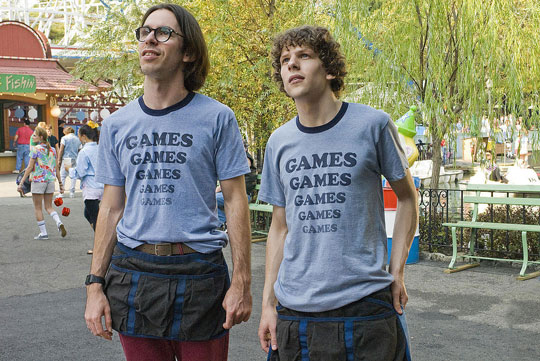
Adventureland (In Theatres)
All things considered, the most telling moment in any director’s career is the follow-up to their first major success. For some, this is the opportunity to capitalize on the momentum of a renowned film to branch out into something a little quirkier or less commercial. Disappointingly, most play it safe by self-consciously emulating the film that put them on the map only with a bigger budget, like Richard Kelly’s attempt to recapture the enigmatic charm of Donnie Darko with the pointlessly obtuse Southland Tales. Promisingly for a relatively inexperienced film director, Greg Mottola opted out of making a louder, more colourful Superbad-style comedy in favour of a surprisingly low-key and sweet film like Adventureland.
Adventureland focuses on dorky college graduate James Brennan (Jesse Eisenberg) and how, as a result of an unexpected cash shortage from his parents, he loses his chance to go on a European vacation with his friends. The year is 1987, well before Job Bank or Kijiji could help a fresh-faced undergrad, so he ends up spending his summer living at home and working for the lame amusement park of the film’s title.
James’ sudden change of plans is but one of many setbacks that befalls him over the course of Adventureland. For every little victory that comes his way, like the free weed he gets from a college buddy, or his instant rapport with sardonic co-worker Joel (Martin Starr), James still falls victim to the childish pranks of a former friend (Matt Bush) and the constant radio play given to Falco’s “Rock Me, Amadeus” (despite that song already being a couple of years old by the film’s timeline). Even Em (Kristen Stewart), the cool Lou Reed fan and designated love interest, is juggling James’ affections alongside her secret affair with Mike Connell (Ryan Reynolds), a struggling musician whose life and marriage is circling down the drain.
Seems like poor James is little more than Charlie Brown with four years of the book learnin’.
Most of you can guess where the film is going from that synopsis. James, despite being a slightly pretentious and awkward virgin, is still going to win the affections of Em, but that’s not really the point. Writer-director Mottola gets around the film’s conventions and its occasionally droopy pacing with some very funny gags and a strong cast. That’s right, even Ryan “the poor man’s Jason Lee” Reynolds. That Mottola manages to get Macro from The Odyssey to act for once proves he’s good with actors. The film isn’t perfect, but it’s likeable and sweet, which elevates it above nearly everything else that’s at the cineplex right now.
Adam Clarke
Whistle to the east
Thu, Apr 9, 2009

After two years on the road, Shanneyganock paused long enough to record their seventh and newly-released studio album, Volume VII. David Keating got in touch with vocalist and guitarist Chris Andrews to ask about the record and their upcoming tour.
Twelve years is a long time in the life of any band. For Shanneyganock, much of that time been spent off the island and on the road as representatives of Newfoundland music. In building their reputation and fanbase, the members of the band—Chris Andrews, Bob Pike, Mark Hiscock and Mike Clarke—have criss-crossed the country non-stop and travelled to destinations as far-flung as Qatar and Memphis, Tennessee.
For a band that thrives on live performance, Chris Andrews says Shanneyganock has had to learn over the years how to transfer their sound to the studio.
“I’m not sure that anyone has it down pat,” he says “but it’s certainly getting more interesting, and not nearly as frustrating. The two major things I have learned about the studio are get a good producer and do a lot of pre-production: these two things are essential.”
One of the stand-out tracks on Volume VII getting radio play is a version of Woody Guthrie’s “Way Over Yonder” — not necessarily the song choice you’d expect from a group labelled a ‘trad band’.
“We have had some great opportunities to play with folk musicians from all over the world and it no doubt has rubbed off a bit,” says Andrews. “I think we have been labelled by many as a diddly-dee band—whatever that is. We just feel we are being ourselves and playing the music we love. Lots of other people love it too, and that’s why we’re still at it.”
Shanneyganock’s tour in support of Volume VII officially launches in mid-May in Carbonear, with a show scheduled for the Arts and Culture Centre in St. John’s shortly after that. A near sold-out benefit for the Stella Burry Foundation is also planned for April 9th at The Bella Vista.
Says Andrews, “The Stella Burry Foundation is a great charity. A couple of friends are on the board and had asked if we could help. It has taken almost a year to get our schedules to fit but it ‘s going to be a fun night.”
The upcoming tour also has the band visiting corners of the province they hadn’t covered in their previous twelve years.
“We are really looking forward to Ramea…It’s a part of the province we have never played. We have been as far as Burgeo, but never had an opportunity to go to the island,” says Chris. Of the rest of the tour, he says, “It’s going to be interesting—we have our only St. John’s area performance and the very next evening in Outer Cove so, once again, we have some pretty interesting travel.”
Only a handful of ticket remain for the April 9th Stella Burry fundraiser featuring Shanneyganock at the Bella Vista. Catch Shanneyganock at the Arts and Culture Centre on May 16th. www.shanneyganock.com
Salted caramels
Thu, Apr 9, 2009
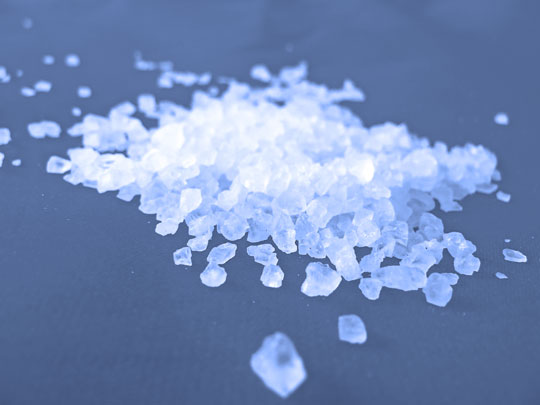
Andreae Prozesky is worth her weight in salt for sure.
I hope I’ve never come off as a salt snob. Really, I’m not. I do use sea salt in most of my cooking and baking, and I specify it in my recipes because I want to record them as accurately as possible. The reason I use it is this: the last time I looked at a box of free-flowing table salt, it had a list of ingredients that read “salt, invert sugar.” Ingredients? Sugar in the salt? What the hell? I mean, I like sugar and salt together, in, say, a bag of salted caramels, or in the form of a DQ Peanut Buster Parfait, but what are those two doing in the same box? No, sir, I don’t like it.
I was living out of St. John’s when I made the sea salt switch, and I selected my salt based mainly on the packaging. The neighbourhood I lived in had a wonderful Greek supermarket, and there was a brand of “award-winning sea salt” on display there. On the side of the container there were artists’ renderings of the various awards that the salt had won, and one of them looked just like an Emmy. Hilarious. How could I not buy Emmy-winning salt? It didn’t hurt that it was cheap as chips. I took my salt home and began to imagine the sorts of acceptance speeches a container of award-winning Greek sea salt would make. Sophisticated form of diversion, I know.
So, as a sea salt user, it doesn’t bother me a mite that there are people out there dusting their chocolate truffles in fleur du sel, or flinging pink and grey mineral salts over their plates like wedding confetti over a set of church steps. And I figure that if you want to pay a fortune for glorious pyramid-shaped salt crystals made of angels’ tears, evaporated by the flapping wings of doves, fine. But here’s the thing: it doesn’t make you better than other people. It might be dead tasty, but it won’t cure what ails you, and if you go around pouring it all over everything you’ll end up with hypertension just like everybody else.
Honestly, the way people are going on about sea salt, you would think it was the new penicillin. I mean, it’s salt. You need a bit of it to stay alive, and you need a lot of it if you’re making popcorn, but it’s still just salt.
This is not to say that the idea that sea salt might be a better nutritional choice than regular table salt is completely unfounded. For one thing, sea salt tends to be sold in coarse form, which means that you’re more likely to be satisfied with a small sprinkling of it atop your food than you would with the same small sprinkling of fine table salt. The nuances of flavour in your meal will be more pronounced, you’ll be more pleased with what you’re eating, a flood of happy emotions will surge through you, and you’ll go for a jaunt in the warm spring evening air instead of having another giant bowl of pasta and passing out on the couch. It’s a roundabout kind of health benefit, but the real ones usually are.
Another potential benefit is that sea salt, coming from sea water, is full of minerals. This is why sea salt is often grey, sometimes pink or red or brownish. You can taste the difference, which is kind of neat. Whether these minerals have any real dietary impact, though, is difficult to judge. You would probably have to eat an awful lot of chunky grey salt for it to count as a magnesium or potassium or iron supplement. And while sea water is mineral-rich, it’s also full of, well, filthy man-made toxins and pollutants, which can just as easily show up as residue on the salt. If your sea salt has been cleaned and refined, the toxins will have been removed, but so will have been the fancy minerals. If the sea salt is unrefined, you’d best be sure it’s from a reputable source (or that it’s won an Emmy).
I suppose there’s an economic factor to consider; if you’re someone who tends to use too much salt, and you replace all the Sifto in your house with snappy gourmet salts at 10$ for a half-cup package, you’re likely to be a tad more judicious in how you season your food. But since the most damaging salt is not the salt you cook with but the nefarious salts that the food giants sneak into your frozen dinners and take-out meals, simply replacing your salt shaker at home with a grinder full of salt chunks probably isn’t going to do anything for your health.
If there is one major advantage that sea salt has over table salt, it’s a karmic one; most table salt is mined, and the conditions for the workers are often cited as atrocious. Mining salt has a host of negative environmental effects, too. Sea salt, on the other hand, is usually produced by small companies, and is available with fair trade and organic certifications. Your body might not be able to tell the difference, but supporting ethical business practices is definitely good for you. Even if that means eating extra salted caramels.
—
SALTED CARAMELS
There’s nothing difficult about making candy, so long as you have a candy thermometer, which you can pick up for a few bucks in the gadgetry aisle of your grocery store. Have all your ingredients and your pan ready to go so that you can keep an eye on the temperature: too low, and you have caramel syrup, too high and you have brittle, filling-removing toffee (neither of which is a terrible thing, mind you).
Makes a whole lot of little bite-sized candies.
1 cup whipping cream
5 tablespoons unsalted butter
2 teaspoons sea salt
1 ½ cups sugar
¼ cup brown rice syrup (or corn syrup if you can’t find brown rice syrup)
¼ cup water
Line an 8-inch square pan with parchment so that there will be enough overhang to pull the caramel slab out of the pan. Brush the parchment with oil and set aside. Fill a glass with cold water and keep it close by to check the doneness of your caramel.
In a small, heavy-bottomed saucepan, bring the cream, butter, and salt to a boil. Remove from heat.
In a large, heavy-bottomed pot, combine sugar, syrup, and water. Stir over medium-high heat until sugar is dissolved. Continue to cook, swirling the pan over the heat (but not stirring), until thermometer reads 248F. Add cream mixture; it will bubble up furiously. Cook, swirling, until the heat has returned to 248F but do not let it go past that point. If you want to test your caramel, drop a bit of it from the tip of a spoon into your glass of cold water; it should form a ball as it sinks to the bottom.
Pour your caramel syrup into the prepared pan and set aside for two hours to firm up. Cut into bite-sized pieces and wrap in waxed paper. If you want to dip each square in tempered chocolate, then go mad. If you have fancy, pretty sea salt, you might want to sprinkle a bit more over for decoration.
Send your questions, comments, and salty suggestions to dreae@thescope.ca
3 Barnes Road
Thu, Apr 9, 2009
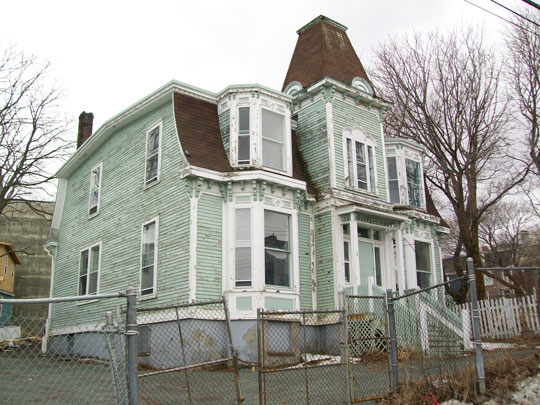
Photo by Alex Pierson
By the time it was finally quenched, the Great Fire of 1892 had left over two thirds of our fair city in smoldering ruins.
Miraculously, some downtown areas were left untouched by the flames, including the house at 3 Barnes Road, where the flames stopped mere feet from the doorstep.
It is now one of the last Second Empire-style structures still standing in the city.
Built in the mid-nineteenth century, it was designed to emulate urban Parisian architecture of the day, where buildings were often constructed tall and narrow in order to maximize space on a smaller lot size in a dense urban landscape. Buildings in this style are characterized by a Mansard roof, dormer windows, and a central tower.
3 Barnes Road has had a rich history as a residence for many prolific business people and politicians, including Irish philanthropist J.W. MacNeily from 1913, and lawyer/writer Richard A. Cramm from 1939.
It was then purchased in 1951 by the Sisters of Mercy (not the band), and became part of the adjacent Academy of Mercy convent school.
The Daybreak Parent Child Centre organization assumed occupancy in 1983, running several of its family programs from the building until 2006.
Today it sits vacant, all dark windows and peeling paint, but still as grand as ever.
— Alex Pierson
Suggestion for a nook? nooks@thescope.ca
Madonna: An Evening of Worship
Thu, Apr 9, 2009

Easter weekend for many people means chocolate, painted eggs, and, of course, Madonna night at The Zone. This year in particular has more people preparing their pointy party hat bras than ever. Why? Well, it’s the annual event’s 20th anniversary. Yep, it was back in 1989 that a bar called Private Eyes threw the city’s first Easter weekend Madonna extravaganza. That year sex and religion just couldn’t get along: the local sexual abuse scandals were hitting the news, and the queen of pop raised eyebrows for featuring burning crosses in her music video for “Like a Prayer”.
“If there are any memories I have of those first years it would have to be the crazy way people would act on the dancefloor, kneeling and praying whenever ‘Like a Prayer’ would come on,” says Zone216 manager Fabian Fitzpatrick. “And of course, being the devil I was, it was always fun to intersperse her video for ‘Like a Prayer’ on the big screen with images of the Pope and Father Hickey from the trip to Newfoundland. After all, it was an evening of worship,” he laughs.
No word on if Madonna herself will show up on April 10 (she might make a stop en route to an international adoption, who knows?), but local drag star Doris Anita Douche will be along to act as stand-in.
Zone 216, No Cover before midnight, $5 after. Friday, April 10, 11pm.
Time warp again
Thu, Apr 9, 2009
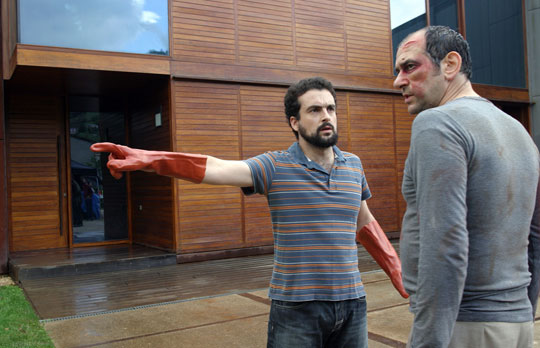
Timecrimes (Los Cronocrímenes) (DVD)
Time travel is not an easy subject to take on in a serious film, even less so in a thriller where the objective is to force the audience to believe in the story enough to be thrilled by it. Luckily Timecrimes, from Spanish director (and star) Nacho Vigalondo, manages to mask the absurdity of its subject matter with oodles of tension and atmosphere. The science fiction elements in the story never weigh down the thriller elements as they might with a less subtle approach. It’s difficult to stop watching, and isn’t the type of movie you can throw on and veg out to. You’ll need to give it your undivided attention if you want to untangle the plot.
Timecrimes tells the story of Héctor (Karra Elejalde), a dopey everyman trying to get some time to relax as he and his wife move into a new home. Héctor briefly spies a young woman removing her clothes in the woods outside his property and, naturally, decides to try and find her. While naked girl-hunting, he’s attacked by some sort of psychotic pink mummy, and thus flees to a nearby mad-science laboratory where he is unwittingly transported a few hours back in time.
This all happens in the first half hour, and believe it or not it gets stranger from there.
Despite its silly premise, the film doesn’t descend into farce, largely because the time-travel trope is played through simply and logically. A few time travel rules are set up, and are followed throughout the movie. That internal consistency allows you to accept its supernatural plot-devices without compromising the movie’s realism.
The film’s greatest strength is its remarkable visual storytelling which creates a perfect balance of subtlety and clarity which forces the viewer to engage with the story but does not make it difficult to do so. The camera lingers on key objects just enough to let us know that what we are seeing will have a greater significance to the narrative than we yet understand. A shot of a bicycle with trash strewn over it assumes a supernatural gravity; we immediately know what we’re seeing will be important later on, and want to know why. Héctor spends the majority of the movie alone and speechless, leaving Elejalde some room to chew the scenery.
Timecrimes is a fun and inventive movie, I recommend that you rent it before the inevitable Hollywood remake is released (slated for 2011), as the advertising for the latter may spoil some of the clever twists in the original (take Quarantine for example.)
Matthew Esteves
DIY: Cookie tin banjo
Thu, Apr 9, 2009

Sharleen Simmons turns a cookie tin into a banjo.
Banjos, ukuleles, mandolins, oh my! If you’re anything like me, you may have a slight obsession with musical instruments. To feed this addiction I often search the interweb for new, interesting, and cheap instruments. That’s where I came across the 4-string cookie tin banjo. Brilliant! I may not be able to afford all the instruments I want, but I sure can try and make them—and so can you.
First, the fun part: finding a cookie tin. Call up every granny you know. You’re bound to strike one, and maybe even get some hard candy in the process. If Nan doesn’t pull through, your next stop is going to be the local second-hand and antique shops.
Make sure the cookie tin is between 10-12’ in diameter or length. Sure, you may get some funny looks running around the store with your measuring tape—I know I did—but that’s all part of the fun. You also want to look at the sturdiness of the tin. Older tins are often made of thicker metal and are stronger. Finally, you should consider the shape. I recommend a round tin. It’s going to be less likely to warp than a rectangular tin.
When you find the perfect tin, you’ll feel an immediate “that’s my banjo” connection. Trust me.
Now for the neck. If you can find an old guitar or banjo neck, go ahead and use it. If not, you’re going to have to find a piece of wood and build your own. I recommend a hard wood—poplar seems to be popular. (Groan!)
Cut your piece so that it’s approximately 1 ½” wide, 1 ¼” thick, and about 35” long. Those 35 inches are divided as follows: The tail of the neck is the diameter/length of the tin – about 11”, the fretboard (from the top of the tin to the nut, the little piece with the grooves in it that guide the strings) should measure about 19”. Leave 5-6” for the head (nut to the top of the neck). If you’re lost with all these terms, check out this diagram at www.tinyurl.com/guitarparts.
Shape the head however you like, just make sure you have room for your four tuners, those knobs you twist to tighten the strings. Drill four holes for them – two on each side of the head, evenly spaced apart.
You can add frets if you like, but this is a little more complicated. I suggest leaving the neck fretless, or simply drawing them on.
Now let’s put it all together! I recommend using the back of the cookie tin as the front of the banjo. This way, you can access the inside of the banjo. Plus, it’s great for storage!
The first thing you want to do is cut a slot in the tin for the tail of your neck to slide through. Use a boxcutter knife and try to make this slot as tight to the neck as you can. Slide your neck through the slot so that the bottom sits on the bottom of the inside of the cookie tin. Then, secure the neck in place by driving a screw from the outside of the cookie tin into the bottom of the neck.
All you need to do now is install the tuners, tailpiece, nut, and bridge. There’s another diagram to orient yourself with at www.tinyurl.com/banjoparts.
Either grab these parts off an old banjo, guitar, or ukulele, or check the local music stores for new or used parts. They’re fairly inexpensive items.
Attach your tuners to the headstock, where you drilled the holes earlier.
Install your tailpiece at the bottom of the front side of the tin.
Place the nut at the top of the neck. The nut should stay in place from the pressure of the strings, but a dab of wood glue doesn’t hurt.
As for the bridge, I glue two pieces of grippy fabric to the tin, under the bridge. This way, the bridge will not slide around on the tin. Now, put your bridge in place just above the tailpiece, and install your strings. Tune it up, and you can start pickin’ out some tunes!
Remember, there are unlimited variations on this plan, so feel free to improvise, pimp it out as much as you like, and have fun with it! Make sure to send any pictures or videos to diy@thescope.ca.
Happy playing!
Illustration by Tara Fleming


Thu, Apr 9, 2009
The Scope